








Tourism in Penzance & West Cornwall
Penzance Town Walk
All the major landmarks of the town can be seen on this walk:-
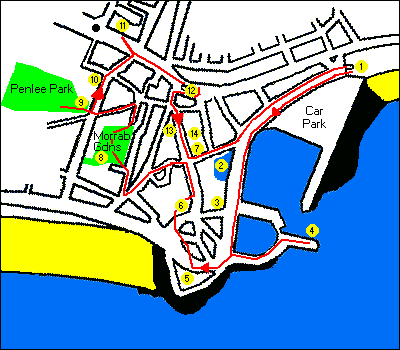
The town of Penzance, with its very compact central area, provides opportunities for easy exploration on foot. While there are many places of interest within the town's central area, this suggested walk introduces the visitor to many of the most important.
From a start at the Tourist Information Centre (1), just opposite the Station, walk along Wharf Road - which circles the harbour - keeping the Car Park and the harbour itself on your left. Within a few hundred yards, you will find the Old Lifeboat House on the right-hand side of the road. Penzance led the way in the past by being the first port in Cornwall to have its own Lifeboat in the early 1800s. While housing the lifeboat for a number of years during the 19th Century, this Lifeboat House became disused when the boat was re-located to Penlee Point, just outside Mousehole. The boat remained based at Penlee until, following the disastrous loss of the boat and crew in the late 1970s, the service was based back at Newlyn Harbour - where it remains today.
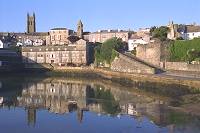
Continuing along the road past the Old Lifeboat House, walk across the Ross Bridge over the entrance to the Abbey Basin (2). This is a "swing" bridge which pivots to allow shipping to pass through into the Abbey Basin to enter and leave the Dry Dock ship repair facility located immediately after the bridge.
Next, you will pass the Boatshed Café & Bar on the right hand side which was originally built as a harbourside warehouse for the export and import of goods all over the world, helping Penzance to become a significant trading port in the days of sail. Immediately after the Boatshed is the Lighthouse Display (3), showing a number of marker buoys used by Trinity House around the South West coastline.
After passing the weighbridge and crossing the small lane that comes down from Chapel Street, you will reach the Dolphin Inn which had long been used by mariners even as long ago as during the Elizabethan era, the period of the Spanish Armadas of 1588 and the 1590s. The Inn is said to be haunted - as are a number of these older hostelries in the town.
On the seaward side of the road is the Inner Harbour, or Wet Dock, which is accessed from the sea by a lock gate. This section of the harbour is used by both pleasure and commercial craft and, on walking along the south pier towards the small lighthouse on its end, you will reach the landing quay for the R.M.V.Scillonian (4) which sails regularly to the Isles of Scilly.
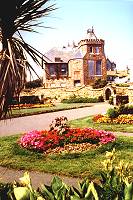
Returning to the main road, pass below a high sea wall and you will reach the Jubilee Open Air Bathing Pool (5) set on the Battery Rocks. The pool - an Art Deco structure and a famous feature of the town - is one of very few such structures which remain of this style of building popular during the 1920s & 30s. The rocks are so named for an old fort which once occupied this site during the Napoleonic Wars. Today, they are a popular location for fishing, bathing and diving. On the right-hand side of the road are the St Anthony Gardens and just behind the Gardens is the Yacht Inn - another building in the Art Deco style of the 1930s.
A little way across the road which comes down from the upper town is a gateway leading into the Churchyard at the rear of St Mary's Church (6), which dominates the entire harbour area. This is located close to the site of the ancient 6th Century Chapel which gave rise to the name of the town - "Pen Sans" in ancient Cornish means "holy headland". The church is a Victorian building and is the parish church of Penzance. Continuing through the churchyard, another gateway leads into Chapel Street - one of the oldest streets of the town.
Turning left and going just a short way up Chapel Street past a house which was once the home of the Bronte sisters, you will reach a cross-roads on which is located the famous Admiral Benbow Inn (7). There are many associations with smuggling here and, on the roof of the Inn, is a Pirate watching all who pass by! The Inn itself was once owned by Roland Morris, a well known local wreck diver who recovered many significant treasures from wrecks in the area, particularly off the Isles of Scilly and a number of these remain in the Inn today.
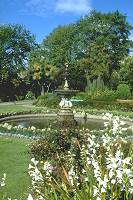
Turning left alongside the Georgian House Hotel, you can walk down the narrow street leading to the attractive Regent Square - a colourful enclave of Georgian houses - and continue until a sign pointing to Morrab Gardens (8) is reached. Enter the Gardens through a small gateway. These are the main public gardens for the town and contain many sub-tropical plants, flowers and trees including palm trees and even a banana plant!
Leaving through the main gateway at the upper right-hand corner of the gardens, a pathway will be found on the left in about 25 yards leading down to Morrab Road. Cross over Morrab Road and immediately on the right is the entrance to Penlee Park in which is Penlee House - home to the Penzance and District Museum and Art Gallery (9). In addition to housing archaeological and other historic relics relating to the history of the town, the Museum and Gallery has regular displays of local art, including frequent shows of the famous "Newlyn School" painters of the early 20th century.
Continue up Morrab Road passing the Public Library (10) outside which is an ancient marine cannon, continue to the traffic-light intersection at the top of the road. Turning left and crossing the road, you will immediately see St John's Hall (11) - an imposing building approached up a wide flight of steps. This is Penzance's "Town Hall" where, in addition to Civic and Municipal functions, frequent exhibitions and shows are held.
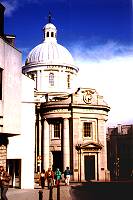
Return back along the main road into the town, again passing the traffic lights at the top of Morrab Road, and continuing through the Greenmarket into Market Place. This lies at the heart of the town at the meeting point of the town's four main streets - Market Jew Street, Chapel Street, Causewayhead and Alverton Street. The Market House (12) - presently housing Lloyds Bank although at one time home to the town market - is located here and its white dome makes this the most prominent building in the town. It is clearly visible and identified from well outside the town..
Pass down the left-hand side of the Market House and, in front of the building, looking down Market Jew Street will be seen the statue to Sir Humphry Davy - Penzance's most well known citizen - who is credited with the invention over 200 years ago of the coal miner's safety lamp and who made many chemical and scientific discoveries.
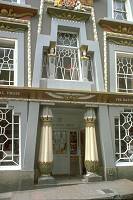
Returning to the upper side of Market Place, turn left into Chapel Street shortly passing the Egyptian House (13) on the right - a façade constructed following a Victorian fashion for dramatic images of Ancient Egypt - and the Union Hotel on the left - where it is reputed that the first public announcement of Lord Nelson's death and victory at the battle of Trafalgar in 1805 were made.
A little further on is the 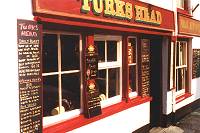 Turk's Head (14) pub, which is thought to be the oldest in Penzance. Indeed, there is said to have been a public house on this site since the 12th century! It is reputed that there are tunnels beneath the Inn leading down to the harbour - which were, no doubt, well used by smugglers in earlier times.
Continue on to the Admiral Benbow again and turn left to walk down the steep roadway onto the Abbey Slip. Turning left at the old Lifeboat House, a short walk along the harbour road will bring you back to the Tourist Information Centre (1).